
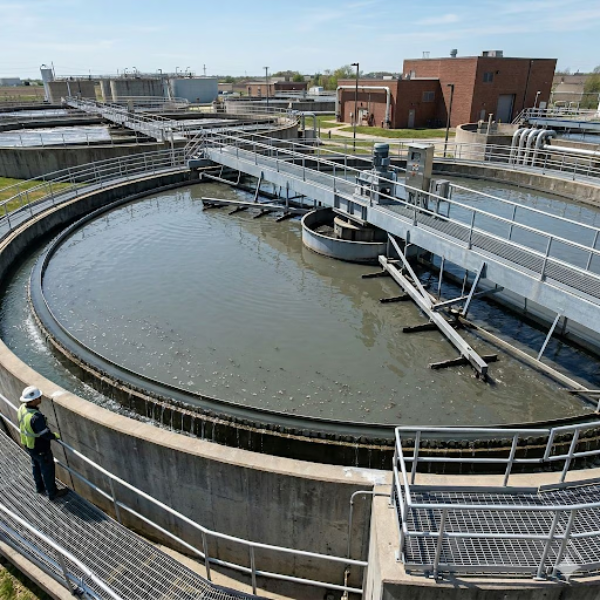
Solid-liquid separation is a critical stage in many water and wastewater treatment processes. When suspended particles need to settle out of water after coagulation, biological treatment, or another process, a properly engineered Clarifier System can provide the necessary separation.
For industrial facilities and infrastructure projects in Nagpur, clarifier selection should be based on hydraulic and solids-loading conditions rather than tank size alone.
Identify the Clarifier's Role
Clarifiers can serve different purposes.
A primary clarifier may remove settleable solids before subsequent treatment. A secondary clarifier may separate biological solids following an activated biological process. Chemical clarification can follow coagulation and flocculation.
Each application has different design considerations.
Before comparing equipment, clearly establish what solids are being separated and what the downstream process requires.
Understand Flow Conditions
Average flow is important, but peak flow can have an even greater effect on clarification.
High hydraulic loading may reduce settling effectiveness and carry solids into the outlet. Flow variation should therefore be evaluated using realistic operating data.
Equalization upstream may help stabilize some industrial wastewater applications.
Study Settling Characteristics
Not all solids settle at the same rate.
Particle characteristics, biological sludge behaviour, chemical floc formation, temperature, wastewater chemistry, and upstream mixing can influence settling.
Where chemical clarification is involved, appropriate testing can help determine suitable coagulation and flocculation conditions.
A Clarifier System cannot compensate indefinitely for poor floc formation upstream.
Review Sludge Removal
Settled solids need to leave the clarification zone effectively.
Poor sludge withdrawal can cause accumulation, septic conditions, solids carryover, and reduced effective capacity. The proposed system should therefore include a suitable sludge collection and withdrawal arrangement.
Facilities should also determine what happens to the sludge after removal.
Thickening, dewatering, storage, and applicable handling practices may be required depending on the treatment process.
Evaluate Mechanical Components
Clarifier performance is not purely a civil-design issue.
Drive mechanisms, scrapers, feed arrangements, overflow systems, sludge withdrawal components, access arrangements, and instrumentation all influence operation and maintenance.
Industrial buyers should consider maintenance accessibility and availability of critical components during proposal evaluation.
Look at the Entire Process
If a clarifier is being installed because an existing plant has high suspended solids in its outlet, the root cause should first be established.
Problems may originate from hydraulic overload, ineffective coagulation, biological process instability, poor sludge settling, equipment malfunction, or unsuitable operating practices.
Simply increasing clarification capacity may not resolve these issues.
Terra Eco Systems Pvt Ltd works with industrial water, sewage, effluent treatment, and pollution-control projects where clarification may be integrated into a broader treatment process.
Nagpur projects can range from manufacturing facilities to institutional and infrastructure developments, each with different wastewater characteristics. Maharashtra facilities should also consider the treated-water or discharge requirements applicable to their specific operations.
Before selecting a clarifier, provide prospective treatment-system designers with representative flow data, wastewater analysis, upstream process information, solids characteristics, available space, required outlet quality, and sludge-management expectations.
Clarification works best when the equipment is matched to the actual separation problem. A technically sound evaluation considers hydraulics, solids loading, upstream chemistry, sludge removal, mechanical reliability, maintenance access, and downstream requirements together.