Choosing ultrafiltration from a turbidity number alone can produce a fouling-prone system that still leaves salts, nitrate, ammonia, and dissolved organics in the water. By the end, you will be able to match UF to a reuse objective, identify the pretreatment and monitoring it needs, and decide when another process or a combined treatment train is the better choice.
Key takeaways
- UF retains suspended solids, colloids, bacteria, and many viruses—not dissolved salts.
- Compare UF with media filtration, microfiltration, nanofiltration, and reverse osmosis.
- Test turbidity, suspended solids, organics, oil, hardness, and disinfectant before selecting membranes.
- Verify flux, pressure, cleaning recovery, and downstream water quality against reuse targets.
What ultrafiltration retains—and what passes through
Commercial ultrafiltration membrane separation is primarily a size-based barrier, not a dissolved-contaminant treatment. Commercial membranes commonly have a nominal UF pore size near 0.01 micrometres and a molecular-weight cutoff between approximately 10,000 and 300,000 daltons, although specifications vary by membrane.
The separation typically looks like this:
- Retained: suspended solids, colloids, bacteria, protozoa, emulsified material, and high-molecular-weight compounds. This is the basis of suspended solids and colloids removal by UF.
- Permeate: water, many dissolved salts, nitrate, ammonia, low-molecular-weight organics, and dissolved metals.
A UF membrane therefore produces clear, low-turbidity water without reliably reducing conductivity, total dissolved solids, nitrate, ammonia, or many dissolved chemical contaminants. Those substances are smaller than the membrane’s effective separation range and pass into the permeate.
Pathogen removal depends on membrane integrity, module construction, operating conditions, and the sensitivity of integrity testing. A fibre break, failed seal, potting defect, or bypass can defeat the barrier. Viruses are harder to retain because many are smaller than UF pores, so do not assign pathogen credit from pore size alone.
Silica requires a form-specific assessment. Particulate, colloidal, or polymerised silica can be retained when its particles exceed the membrane’s separation range; truly dissolved reactive silica passes through. UF is not a dependable treatment for dissolved reactive silica.
When UF adds value compared with other treatment processes
UF adds value when the problem is suspended or colloidal material, not dissolved contamination. It suits polishing biologically treated secondary effluent, producing low-turbidity reuse water, recovering process water, and separating colloids from industrial wastewater. It also protects RO by reducing particulate fouling and cartridge loading.
| Option | What it removes | When it applies |
|---|---|---|
| UF versus clarifier | Colloids, fine solids, bacteria and protozoa | Use UF after clarification when settling will not produce the required low turbidity |
| UF versus multimedia filter | Smaller colloids and finer suspended matter | Use a multimedia or pressure filter for larger suspended particles at lower complexity |
| UF versus cartridge filter | Bulk particulate load before final protection | Use a cartridge filter as the final guard; UF can extend cartridge life |
| UF versus activated carbon and softener | UF retains particles; carbon adsorbs selected dissolved organics; a softener exchanges calcium and magnesium | Choose carbon for targeted organics and a softener for hardness |
| RO | UF does not remove dissolved salts or reduce conductivity | Use RO for dissolved salts, nitrate, ammonia and other dissolved scaling constituents |
UF improves RO feed quality, but it does not remove calcium, magnesium, silica, or other dissolved species that can still scale an RO system. Confirm the reuse target before selecting it.
UF is the wrong first choice when:
- Dissolved contamination dominates the feed; select RO, adsorption, ion exchange or another targeted process.
- Solids vary sharply without equalisation and pretreatment; fouling and recovery will become unstable.
- No workable route exists for backwash water, cleaning chemicals, concentrate and sludge; the membrane system then shifts its waste problem downstream.
How to assess and condition the feed before membrane selection
Specify UF only after a UF feed-water assessment, not from turbidity alone. Collect samples across production peaks, start-ups, washdowns, and seasonal changes; one convenient sample can conceal the load that causes fouling.
- Measure turbidity and TSS, particle-size distribution, oil and grease, COD, BOD, SDI, temperature, pH, conductivity, hardness, silica, oxidants, and microbiological load.
- Test for dissolved and colloidal organic matter, algae-derived material, iron, manganese, and residual coagulant. Low turbidity does not exclude any of these foulants.
- Record flow variation, equalisation capacity, chemical additions, cleaning history, and the proposed backwash and waste routes.
Condition the feed according to what the profile shows:
| Condition | Upstream treatment | What can go wrong |
|---|---|---|
| Biodegradable solids, untreated biomass, oil, algae, or floc | Biological treatment and clarification before UF | Rapid fouling, blocked fibres, and poor recovery |
| Colloids or natural organic matter | Coagulation before UF, with jar tests for dose, mixing, and contact time | Residual coagulant, sludge generation, or floc breakthrough |
| Highly variable solids | Equalisation and solids control | Peak loading overwhelms the membrane |
Coagulation is feed-specific: excessive chemical dosing creates more sludge, while weak floc destabilisation can send particles into the membrane. Pilot testing should establish fouling rate, cleaning demand, recovery, and temperature impact; colder water increases viscosity and changes achievable flux.
How module design, flow mode, and cleaning affect UF performance
Compare UF configurations against the feed and operating duty, not pore size alone. Solids loading, oil content, required recovery, footprint, backwash access, and cleaning capability determine the practical choice. Hollow-fibre versus spiral-wound UF is a starting comparison, not a specification.
| Option | Operating difference | Main trade-off |
|---|---|---|
| Hollow-fibre | Fibres support dead-end or crossflow operation; outside-in flow exposes the outer surface to feed | Tolerates backwash and air scour, but oil and solids can foul fibre surfaces |
| Spiral-wound UF | Inside-out flow through membrane channels | Compact, but narrow channels restrict backwash access and suit cleaner feeds |
| Dead-end and crossflow UF | Dead-end sends all feed toward the membrane; crossflow sweeps solids along it | Dead-end uses higher recovery; crossflow controls cake formation but creates reject |
| Submerged and pressurised UF | Submerged modules use vacuum or suction in a tank; pressurised UF uses feed pumps in sealed skids | Submerged systems offer large tank footprints; pressurised skids simplify containment and modular installation |
UF fouling and cleaning requires identifying the deposit before selecting a remedy. Particulate cake responds to hydraulic backwash and air scour; organic adsorption needs chemically enhanced backwash; biofouling needs biocidal or oxidising cleaning compatible with the membrane; inorganic scaling needs a scale-removing chemical. Chemical or physical damage is irreversible—replace the module.
Raising transmembrane pressure can hide falling flux while compacting foulants.
Specify normalized permeability or normalized flux, transmembrane pressure, recovery, and cleaning frequency alongside flux, correcting for temperature-dependent viscosity. Include backwash water, cleaning waste, spent cartridges, and reject handling in the water and waste balance.
How to verify UF as part of a complete reuse treatment train
Before accepting UF for reuse, prove that it meets a defined water-quality target and remains an intact barrier under operating conditions. Set the target first: low turbidity and suspended solids, RO protection, industrial process-water quality, or a high-consequence public-health application.
1. Match each target to a treatment barrier. UF alone is not reliable for dissolved salts, conductivity, nitrate, ammonia, many dissolved metals, low-molecular-weight organics, or every industrial chemical. Specify nanofiltration, ion exchange, adsorption, biological treatment, ultraviolet, advanced oxidation, or another validated barrier; use UF followed by RO when dissolved-salt removal is required.
2. Verify the pathogen barrier, not merely the permeate appearance. Maintain continuous filtrate-turbidity monitoring, set alarm limits, and define automatic isolation when turbidity rises. Run UF integrity testing through pressure-decay or vacuum testing suited to the module, with a failed-test response covering fibre breaks, potting defects, seal failures, valve leakage, and instrument faults.
3. Prove performance with representative feed and pilot data. Check recovery, fouling rate, cleaning demand, temperature effects, reject handling, and downstream quality rather than relying on one turbidity result.
Terra Ecosystems Pvt Ltd can connect feed testing, pilot results, membrane selection, pretreatment, cleaning, reject handling, and downstream treatment into one design. That whole-train fit matters more than the UF skid alone.
Related product
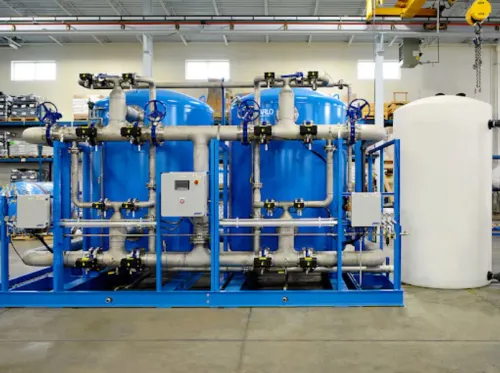
 | ULTRAFILTRATION SYSTEM Ultrafiltration (UF) is a pressure-driven process that removes organics, emulsified oils, metal hydroxides, emulsions, dispersed material, suspended... View product → |
Frequently asked questions
What does an ultrafiltration membrane retain, and what passes through?
UF retains suspended solids, colloids, bacteria, and many viruses through a size-based barrier. Water, dissolved salts, small dissolved molecules, and some dissolved organics pass through.
When does ultrafiltration add value compared with other treatment processes?
UF adds value when you need reliable removal of fine particles and microorganisms before reverse osmosis, disinfection, or reuse. Compare it with media filtration and microfiltration for solids removal, and with nanofiltration or reverse osmosis for dissolved contaminants.
How should you assess feed water before selecting UF membranes?
Test turbidity, total suspended solids, particle size, temperature, pH, oil and grease, organic load, hardness, iron, manganese, disinfectant residual, and biological activity. Use the results to select pretreatment, membrane material, pore rating, and cleaning chemicals.
How do module design, flow mode, and cleaning affect UF performance?
Choose hollow-fibre or flat-sheet modules for the feed and operating duty, then set dead-end or cross-flow operation according to solids loading. Control flux, transmembrane pressure, backwash frequency, air scour, and chemically enhanced cleaning to limit fouling and restore permeability.
How can you verify UF as part of a complete water reuse treatment train?
Define the intended reuse quality, sample UF feed and permeate, and track turbidity, pathogen indicators, conductivity, pressure, flux, and cleaning recovery. Confirm that downstream processes address contaminants UF does not remove, such as dissolved salts.