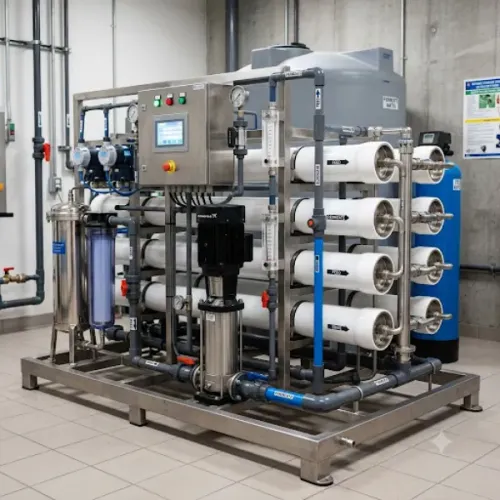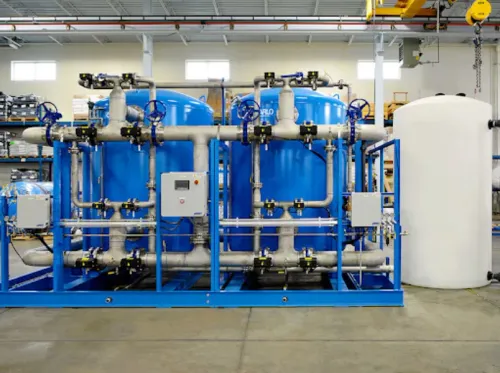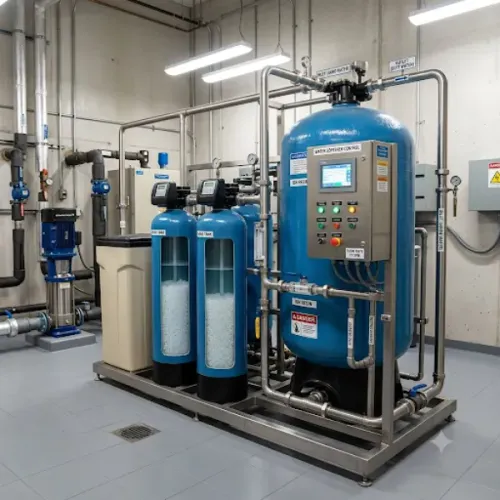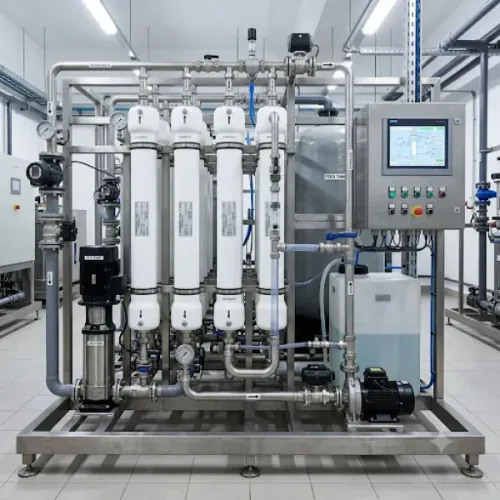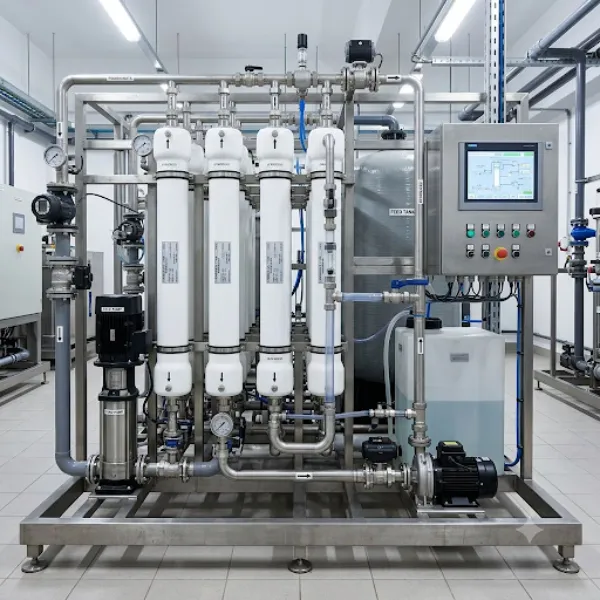
Water reuse projects often require a treatment barrier capable of handling fine suspended material before water reaches sensitive downstream equipment. An Ultrafiltration System can perform this role through membrane-based physical separation, making it relevant to selected industrial water-treatment and wastewater-reuse applications.
For industries in Nagpur and other industrial areas of Maharashtra, UF is particularly worth evaluating when consistent particle removal is needed before advanced purification.
What an Ultrafiltration System Actually Removes
Ultrafiltration membranes contain very small pores that retain suspended solids, colloidal material, and many microorganisms while allowing water and smaller dissolved substances to pass through.
This distinction is important.
UF is highly effective for fine particle separation, but it is not primarily intended to remove dissolved salts in the same way as reverse osmosis.
If high TDS is the main water-quality concern, UF alone will not solve the problem.
UF Can Strengthen a Reuse Treatment Train
Industrial water reuse usually requires several treatment barriers working together.
An existing wastewater treatment plant may first reduce organic pollution and suspended solids. Additional clarification, filtration, UF, disinfection, RO, or other polishing processes may then be considered depending on the intended reuse.
UF can provide a more consistent feed to downstream membrane treatment by reducing fine particulate loading.
Potential applications may include:
- Wastewater polishing
- RO pretreatment
- Process-water preparation
- Selected recycling systems
- Surface-water treatment
- Utility-water improvement
Each application should have a defined outlet-quality target.
Compare UF With Conventional Media Filtration Carefully
Pressure media filters and UF membranes do not perform exactly the same function.
Conventional filtration can provide economical removal of suspended matter in many applications. UF offers a finer membrane barrier and can provide more consistent particle separation when correctly operated.
However, UF also introduces membrane cleaning requirements, pressure monitoring, integrity considerations, and operating procedures that need to be planned.
The more advanced technology is not automatically the better choice. The correct technology is the one that achieves the required water quality reliably at an acceptable lifecycle cost.
Feed Conditions Influence Membrane Performance
UF membranes can foul when feed-water conditions are poorly controlled.
A project assessment should therefore examine turbidity, suspended solids, organics, iron, biological conditions, temperature, and any unusual contaminants relevant to the water source.
Operating teams should also understand backwashing, chemically enhanced cleaning where applicable, membrane cleaning procedures, differential pressure, permeate flow, and routine monitoring.
Start With the Intended Reuse
One of the most useful questions is also the simplest.
Where will the treated water go?
Water intended for landscaping, washing, cooling-related use, process reuse, or feed to RO may require different treatment standards and configurations. Establishing the reuse destination first allows engineers to work backwards and select appropriate treatment barriers.
Terra Ecosystems Pvt Ltd provides water and wastewater treatment solutions for industrial and infrastructure requirements, including membrane-based configurations.
For projects in Nagpur, Maharashtra, an Ultrafiltration System should therefore be selected because it performs a defined separation function within the overall treatment process, not simply because membrane treatment sounds advanced.
A reuse project becomes more technically sound when inlet water quality, target quality, membrane loading, cleaning strategy, recovery, downstream treatment, operating skills, and lifecycle requirements are evaluated together.
Keywords