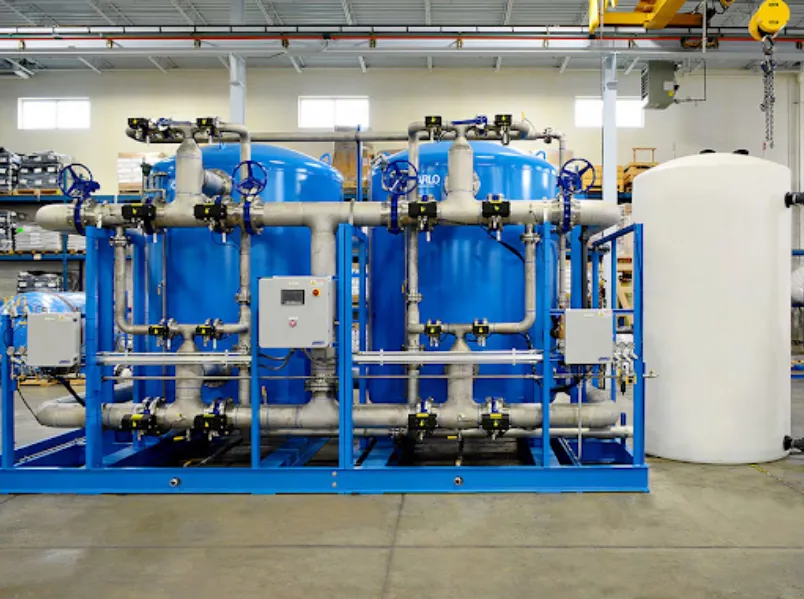
Hard water can quietly increase operating problems across an industrial facility. Calcium and magnesium salts can contribute to scale formation on heat-transfer surfaces, pipelines, heaters, boilers, and process equipment. Over time, these deposits may restrict flow, reduce heat-transfer efficiency, and increase cleaning requirements. A Water Softening Plant is designed to reduce hardness when softer water is required for a particular industrial application.
For facilities in Nagpur and across Maharashtra, the decision to install a softener should begin with water analysis rather than assumptions based on appearance or taste.
Understanding the Water Softening Plant Process
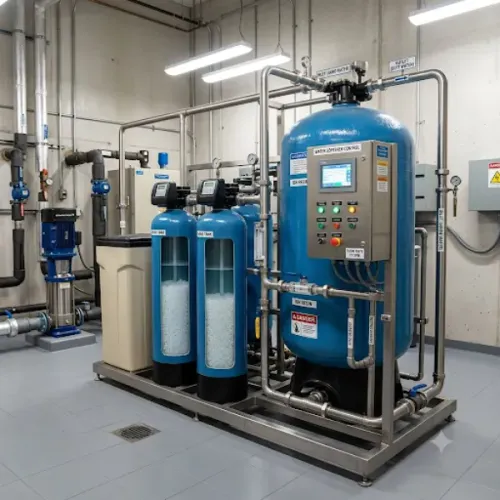
Conventional industrial softening commonly uses ion-exchange resin.
As hard water passes through the resin bed, hardness-forming calcium and magnesium ions are exchanged for sodium ions. Once the resin reaches its working capacity, it needs regeneration using a suitable brine solution.
The operating cycle generally includes service, backwashing, regeneration, rinsing, and return to service.
Automation can help control these stages, but correct settings still depend on actual water quality and consumption.
Where Hardness Creates Operational Problems
Hardness can become particularly important where water is heated, concentrated, evaporated, or used in equipment that has specific feed-water requirements.
Potential applications for softened water include:
- Boiler feed pretreatment
- Cooling-related applications
- Hot-water systems
- Laundry facilities
- Selected manufacturing processes
- Pretreatment before further purification
- Institutional utility systems
The required residual hardness can differ significantly between applications.
Why Softening Is Different From Complete Purification
A common misunderstanding is that softened water is equivalent to demineralised water.
It is not.
Softening primarily addresses hardness-forming ions. It does not remove all dissolved salts from the water. If an industrial process requires very low total dissolved solids, a different treatment technology such as reverse osmosis, demineralisation, or a combined treatment sequence may be necessary.
Understanding the final water-quality requirement prevents the softener from being asked to perform a job it was not designed to do.
Size the System Using More Than Flow Rate
A softener must be sized around both water demand and hardness load.
Useful design information includes:
- Raw water hardness
- Peak flow
- Daily water consumption
- Required treated-water hardness
- Operating hours
- Regeneration frequency
- Available space
- Brine preparation requirements
- Downstream water use
Ignoring hardness concentration can result in a system that appears adequate by flow capacity but requires excessive regeneration.
Keep Performance Stable Through Routine Checks
Operators should periodically check inlet and outlet hardness, salt consumption, regeneration frequency, pressure conditions, resin performance, and control settings.
Unexpected hardness leakage may indicate exhausted resin, incorrect regeneration, excessive flow, valve problems, or changes in incoming water quality.
Terra Ecosystems Pvt Ltd works with industrial water-treatment projects where softening can be integrated with filtration, membrane treatment, demineralisation, and other processes.
For businesses in Nagpur, Maharashtra, the value of a Water Softening Plant comes from matching the technology to a genuine hardness-related requirement. Testing the source water, understanding equipment sensitivity, and calculating demand accurately provide a much stronger basis for investment than installing a softener simply because the raw water is described as hard.
Keywords