A water system needs demineralisation when dissolved ions, silica, alkalinity, or conductivity threaten the process—not simply when the feed water looks dirty or saline. By testing the feed, defining the outlet limits, and matching the treatment train to the application, you can decide whether two-bed ion exchange is enough or whether polishing, EDI, membranes, or additional controls are necessary.
Key takeaways
- Use a DM plant when dissolved ions threaten boilers, laboratories or production quality.
- Compare DM with RO and softening; they remove different contaminants and are not interchangeable.
- Base the treatment train on feed-water conductivity, hardness, silica, alkalinity and chloride.
- Specify regeneration chemicals, purity monitoring, automation and supplier responsibilities before purchasing.
When dissolved ions make a DM plant necessary
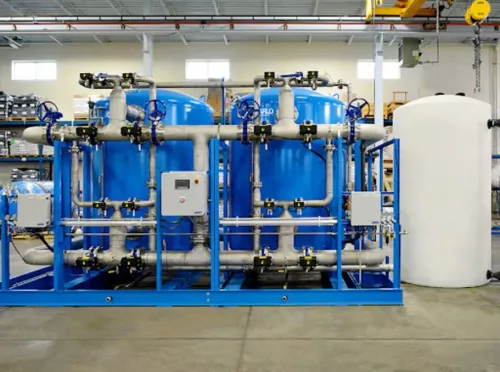
The practical DM plant definition is a system that removes dissolved ions by ion exchange. Cation exchange replaces calcium, magnesium and other positive ions with hydrogen ions; anion exchange replaces chloride, sulfate, bicarbonate and silica species with hydroxide ions. Hydrogen ions and hydroxide ions combine to form water.
1. Test the feed water for conductivity, total dissolved solids, hardness, alkalinity, silica, chloride, sulfate and temperature. A supplier cannot size the resin beds reliably from TDS alone.
2. Compare those results with the process limit. A DM plant is justified when conductivity or resistivity, silica or specific ionic contaminants must stay below the level that softened or ordinary RO water can deliver.
High-pressure boilers, steam generation, pharmaceutical and laboratory work, electronics manufacturing, battery production and ion-sensitive chemical formulation commonly fall into this category.
3. Specify the operating temperature and purity target. A limit such as 10 microsiemens per centimetre requires a different treatment decision from water approaching 18.2 megohm-centimetres at 25 °C.
4. Check contaminants beyond ions before choosing DM alone. Ion exchange does not reliably remove microorganisms, endotoxins, neutral organics, dissolved gases or suspended particles, so pretreatment, membranes, filtration and sanitary storage may be necessary.
Do not treat high resistivity as proof of pharmaceutical Water for Injection compliance. WFI also requires controlled microbiology, endotoxin performance, sanitization, storage, circulation, monitoring and validation.
How a DM plant compares with RO, softening and polishing systems
An RO permeate can still carry residual sodium, chloride, silica and other ions; that is why a softener or membrane alone does not equal demineralised water.
| System | Removes | Leaves behind or adds |
|---|---|---|
| Water softener | Calcium and magnesium hardness | Sodium, chloride, silica, alkalinity and other dissolved ions |
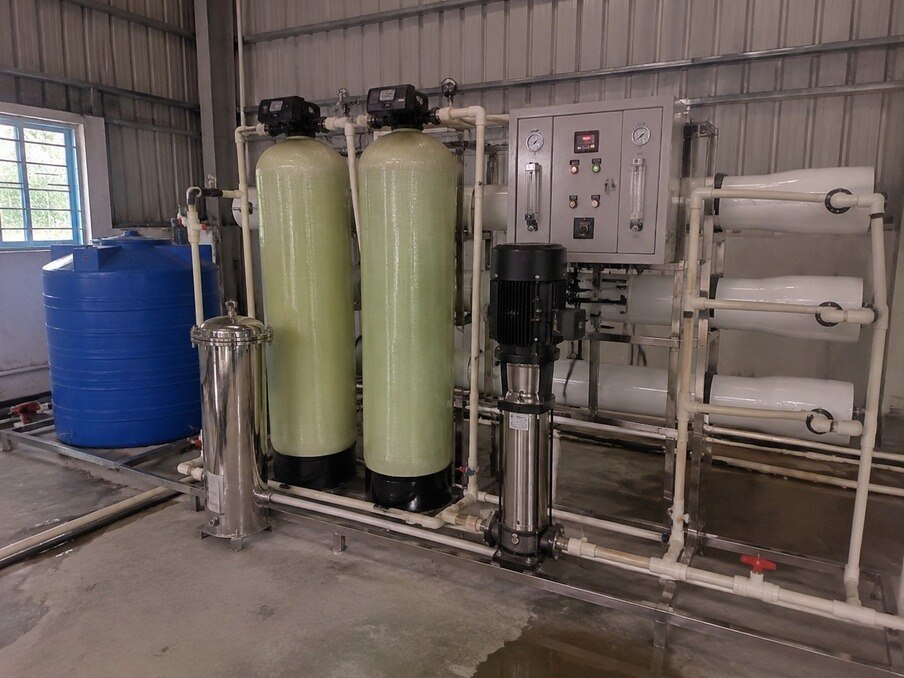
| Reverse osmosis | About 95–99% of dissolved salts, plus suspended solids | Residual ionic load, dissolved gases and some small neutral compounds |
| Two-bed DM plant | Cations and acid anions through hydrogen- and hydroxide-form exchange | Neutral organics, microorganisms, endotoxins, gases and particles |
| Mixed-bed polisher | The remaining ionic traces after primary treatment | Non-ionic contaminants and biological contamination |
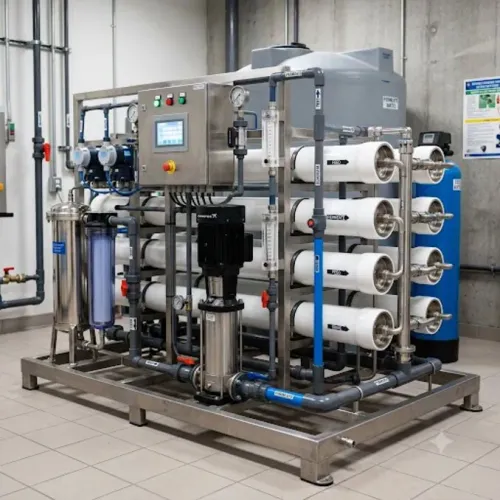
| Electrodeionisation system (EDI) | Dissolved ions continuously, without chemical regeneration during normal operation | Organics, microbes, endotoxins and particles |
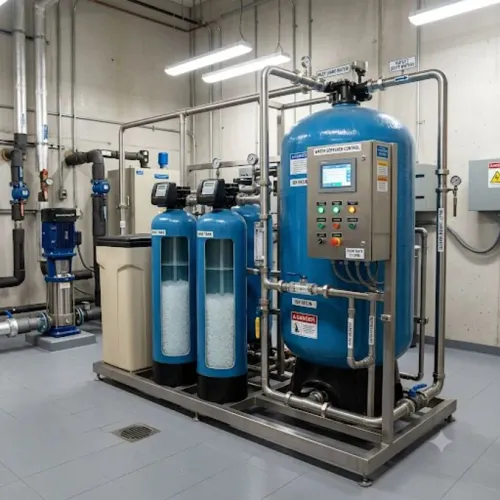
A conventional DM plant uses a strong-acid cation bed followed by a strong-base anion bed. The cation resin replaces dissolved positive ions with hydrogen; the anion resin replaces negative ions with hydroxide, and the two form water.
Use a mixed-bed polisher or electrodeionisation system (EDI) after reverse osmosis when the process needs low- or sub-microsiemens-per-centimetre water. A mixed-bed outlet can approach 18.2 megohm-centimetres at 25 °C, but that reading proves ionic purity only.
Add activated carbon, ultraviolet treatment, ultrafiltration, final filtration and sanitary storage when organics, microbes, endotoxins or particles matter. A DM plant alone does not make Water for Injection, regardless of its resistivity reading.
How to build the treatment train from a raw-water analysis
A raw-water analysis must determine more than total dissolved solids: it must show which ions will consume each resin and which contaminants will shorten resin life. Record calcium, magnesium, sodium, chloride, sulphate, bicarbonate, silica, iron, carbon dioxide, pH, alkalinity, hardness, temperature, turbidity, suspended solids and free chlorine across seasonal and upset conditions.
Use those results to build the sequence:
- High calcium and magnesium call for softening or RO before ion exchange; hardness leakage can scale anion resin and increase pressure drop.
- High iron, manganese, turbidity, oil or natural organic matter requires filtration and contaminant control before the DM vessels.
- Free chlorine requires activated carbon or another validated dechlorination step because oxidants attack anion resin.
- High bicarbonate and carbon dioxide increase anion loading; place a degasser after cation exchange when the calculated CO₂ burden justifies it.
- Silica, boron and sodium require direct limits and monitoring because conductivity can remain deceptively low while these species break through.
| Feed-water result | Design decision | What goes wrong if missed |
|---|---|---|
| Calcium and magnesium | Softener or RO before cation–anion beds | Scaling and rapid capacity loss |
| Bicarbonate and carbon dioxide | Cation bed followed by degasser where needed | Anion exhaustion and low product resistivity |
| Silica and boron | Select suitable strong- or weak-base anion capacity and monitor directly | Conductivity passes while process-critical contaminants break through |
| Chloride and sulphate | Size anion resin for their combined load | Early anion exhaustion |
| Iron and suspended solids | Clarification, filtration or iron removal before resin | Fouling, channeling and pressure drop |
Check the supplier’s design envelope before choosing EDI: it normally needs low-hardness RO permeate with controlled chlorine, silica, carbon dioxide, iron and suspended solids.
Choosing purity targets for boilers, laboratories and production lines
A single conductivity target cannot serve every process. High-pressure boilers and steam generation need control of conductivity, silica and sodium because volatile contaminants can reach turbines, form deposits and accelerate corrosion; the limits depend on pressure, metallurgy and cycle chemistry.
| Process | Main specification focus | Why it matters |
|---|---|---|
| High-pressure boilers and steam generation | Conductivity, silica, sodium, chloride and dissolved gases | Prevents turbine deposition and corrosion-product transport |
| Pharmaceutical water | Chemical quality, TOC, microbes and endotoxin | Pharmaceutical water requires qualified production, storage, circulation, sanitization and validation; 18.2 megohm-centimetre water alone is not Water for Injection |
| Laboratory water | Resistivity, conductivity, TOC, particles and microbiology | Analytical instruments and biological tests need different contaminant controls |
| Electronics manufacturing | Resistivity, silica, boron, particles, TOC and metals | Trace ions and weakly ionized species can damage wafers or leave defects |
| Battery production and chemical formulation | Conductivity, chloride, hardness, metals and process-specific ions | Contaminants can alter reactions, electrolytes, coatings or product stability |
Conductivity and resistivity mainly show ionic contamination. A mixed-bed outlet can read near 18.2 megohm-centimetres while bacteria, endotoxin, particles or biofilm remain unacceptable. Test silica or boron directly where they affect performance; carbon dioxide, boric acid and silica can escape detection at important concentrations.
Define the target from the process recipe, temperature, exposure point and failure consequence, then select monitoring that measures each critical contaminant.
Selecting the operating model, controls and supplier scope
Choose on the full operating envelope, not outlet resistivity alone. Compare capital cost, water recovery, consumables, operator exposure, downtime and wastewater obligations before selecting a train.
| Option | Operating model | Check before purchase |
|---|---|---|
| Two-bed DM plant | Regenerable cation and anion beds; economical at steady, high flow | Confirm regeneration chemicals, acid and caustic storage, neutralisation, wastewater storage and disposal |
| Mixed-bed polishing | Final ion-removal stage after RO or two-bed DM | Verify inlet conductivity, resin separation, regeneration or replacement method, and required recirculation |
| EDI | Continuous polishing of RO permeate without routine chemical regeneration | Confirm EDI feed requirements for hardness, chlorine, silica, carbon dioxide, iron, manganese and suspended solids |
| RO-plus-polishing | RO removes most salts; EDI, mixed bed or cartridge DI removes residual ions | Compare recovery, membrane replacement, polishing capacity and upset protection |
Specify controls in the quotation: conductivity or resistivity alarms, silica monitoring where relevant, flow and pressure trips, leak detection, online temperature compensation, data logging and a defined sanitisation method. EDI loses reliability when pretreatment fails; a hardness breakthrough can scale its compartments.
Ask each supplier for a mass balance, resin or membrane replacement schedule, regeneration chemicals consumption, wastewater volume, and commissioning performance test. For pharmaceutical Water for Injection, 18.2 megohm-centimetre water is not proof of compliance; storage, recirculation, microbiological and endotoxin monitoring, sanitisation and validation remain in scope.
Include Terra Ecosystems Pvt Ltd in the same technical comparison, requiring it to state which pretreatment, polishing and monitoring responsibilities it will supply.
Frequently asked questions
When is a DM plant required for industrial water?
A DM plant is required when dissolved ions such as calcium, chloride, sulfate or silica must be removed to protect equipment or meet process-water purity targets.
How does a DM plant compare with RO, softening and polishing systems?
A DM plant removes ions through cation and anion exchange. Softening mainly removes hardness, RO rejects many dissolved contaminants through a membrane, and polishing treats an already purified stream to reach a tighter specification.
What raw-water data is needed to design a DM treatment train?
Obtain a laboratory analysis covering conductivity or TDS, pH, hardness, alkalinity, chloride, sulfate, silica, iron, suspended solids and temperature, then match pretreatment and resin capacity to the results.
How should purity targets differ for boilers, laboratories and production lines?
Set targets from the equipment or process specification, including conductivity, silica, hardness and sodium limits; boiler make-up water and laboratory or production water do not share one universal purity level.
What should you include when selecting a DM plant supplier?
Define flow rate, water-quality guarantees, regeneration chemicals, instrumentation, automatic controls, resin replacement, operator training, maintenance and the boundary between supplier and site responsibilities.